Hig and Cima’s relationship
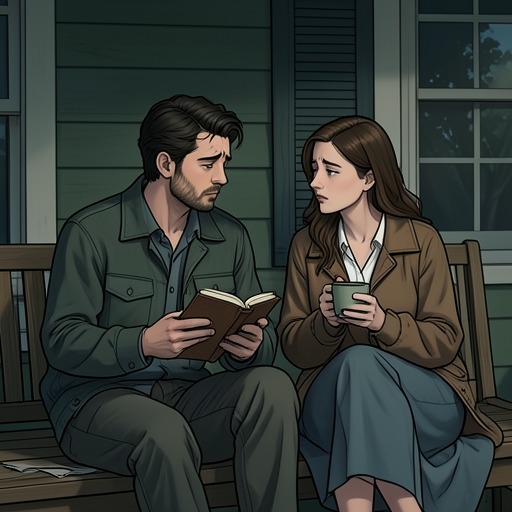
The Dog StarsHig and Cima’s relationship begins under the pressure of distance and uncertainty, then deepens through shared work and tentative intimacy. Its promise is real, but so is the grief each carries: their growing closeness cannot simply erase the dead, and the memory of Tomas eventually alters the way they approach one another.
First Sight and Recognition
Hig first sees Cima in the garden, bent among the plants. She stands to watch his plane, shading her eyes; she is tall, lanky, and dressed in shorts and a man’s shirt tied at the waist. The first image of her is therefore one of attention across a distance: she is looking up at Hig as he looks down toward her, each trying to understand the other across an uncertain divide.
That distance becomes more charged when Hig sees Cima beside Pops, both standing in the cattails with their guns held out to the side. From the aircraft, and then through his rifle scope, Hig studies her features and reads a mixture of fear and amusement in her expression. His gaze shifts from tactical observation to unmistakable attraction. The scope makes the moment intimate and remote at once: he can examine her closely, but their encounter still takes place in the conditions of armed caution.
Their first formal exchange is marked by a hand offered. It gives the encounter a simple human gesture after the earlier armed watchfulness. Hig’s attention to Cima is already personal, but the relationship itself has not yet moved beyond recognition and the possibility of trust.
A Shared Daily World
The relationship develops through ordinary work rather than declarations. Hig finds Cima weeding in the garden and squats beside her to pull weeds. He tells her that he and his companion have a garden too; Cima acknowledges this. The exchange links their separate domestic routines and offers a small point of common ground in a world where ordinary life has become difficult to sustain.
Their time together includes gardening and cleaning vegetables, as well as long conversations. Hig says they seem to talk continually, yet he is also comfortable with the silences between them. Those pauses are not presented as emptiness: birds, bats, leaves, and the lowering creek continue around them. The natural sounds give their companionship a rhythm that does not depend on constant speech. For Hig, being at ease beside Cima is itself a meaningful change.
The relationship’s gradual character matters. Their closeness accumulates in repeated, modest encounters: working in the same garden, sharing food preparation, and remaining together without needing to fill every quiet moment. When their hands touch over a pot of peas, Cima leaves her fingers resting over Hig’s briefly. Hig experiences the contact as a threshold. He is struck by her steady, open gaze, but recoils from the intensity of what that openness seems to ask of him. Cima smiles inwardly and returns to the task. The moment conveys attraction without turning it into a guarantee of readiness.
Intimacy and Its Limits
Eventually, their attraction becomes physical. For Hig, kissing Cima is an experience of disorientation and reassembly: he describes his sense of self coming apart and gathering around her. The intensity is not uncomplicated. When Cima experiences pain, Hig immediately stops and moves away. The encounter makes the difference between desire and mutual ease unmistakable; closeness requires attention to what Cima is experiencing, not merely surrender to Hig’s feelings.
Later, Hig apologizes, and Cima explains that she has been dreaming repeatedly about Tomas. In the dream, Tomas is dying and calling for her, while she stands back, unable to help. She identifies him as her husband and best friend. Her account gives the earlier difficulty a context: the past is not an abstract sorrow but a specific relationship and a remembered failure of presence that continues to trouble her. Hig’s response is panic and tears; Cima, after initially appearing emotionally guarded, also begins to cry. Their grief becomes something they witness together, although witnessing it does not make it disappear.
Grief Within the Relationship
The losses each brings to the relationship are distinct. Hig continues to dream of Melissa and Jasper and becomes sadder even during the respite he finds with Cima. Cima’s grief centers on Tomas and on the dream of having failed to answer him in his final hours. Their new attachment therefore grows alongside older bonds rather than replacing them. The narrative places tenderness and mourning in the same emotional field: comfort is possible, but it does not cancel memory.
After Cima shares her dream, the pace of their intimacy changes. Pops reports that the highway is straight and clear for at least a thousand feet, marking the practical preparations around them, while Cima is described as warmer but more withdrawn. She comes to the hammock, but not every night or even every other night. Hig counts five days before they again approach physical intimacy. This detail reveals his longing and impatience, but the encounter remains tentative: they hold each other quietly, and Hig becomes aware that Cima is uncomfortable. His thoughts turn to the image of Tomas from her dream, and panic interrupts the moment.
An Unresolved Attachment
Hig and Cima’s relationship is not presented as a simple passage from loneliness to happiness. Its movement is from guarded observation toward companionship and desire, then toward a more difficult intimacy shaped by bereavement. Cima’s brief touch over the peas and her later retreat belong to the same developing relationship: openness is possible, but it is not constant or effortless. Hig’s attraction does not make him immune to fear, and Cima’s willingness to be close does not mean she has finished grieving.
The relationship’s significance lies in this unfinished negotiation between connection and loss. Shared work and silence establish a form of trust; the painful interruption and the conversation about Tomas expose the limits of that trust without ending it. Hig and Cima become capable of meeting one another in vulnerability, but the evidence leaves their future unsettled. Their intimacy remains a beginning shaped, at every step, by the people they have lost.